The Meeting Bingo Card: A Field Guide to Corporate Buzzword Bingo
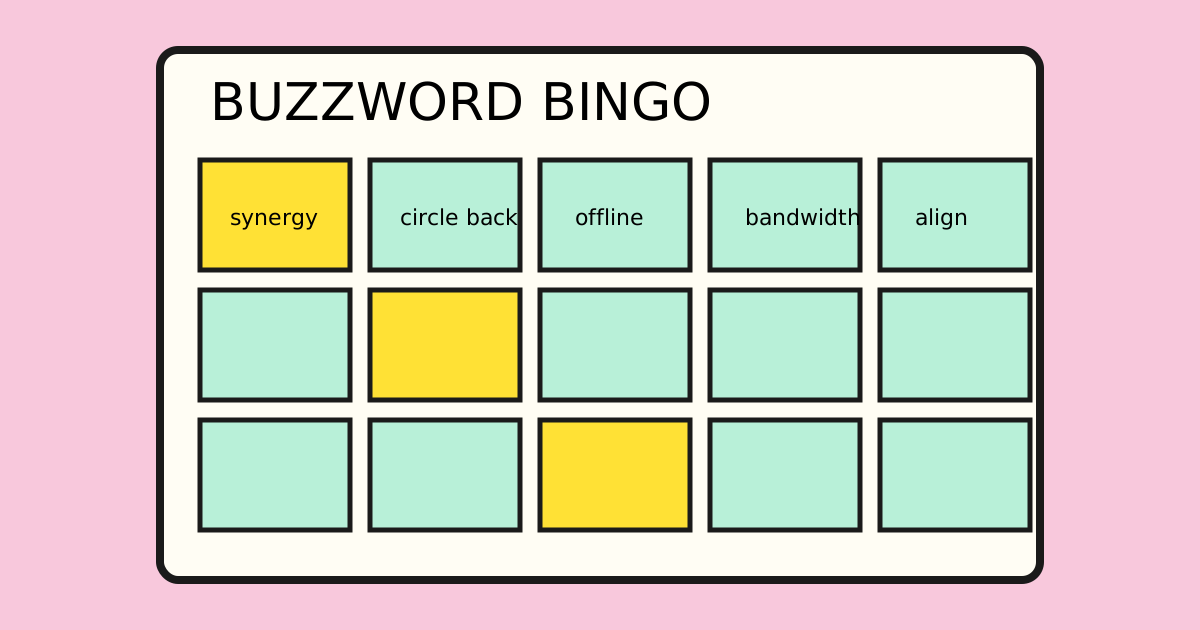
# The Meeting Bingo Card: A Field Guide to Corporate Buzzword Bingo
The short answer: Meeting Bingo isn't just a silly game; it's a subversive act of reclaiming your attention and sanity in the face of corporate jargon overload, transforming tedious hours into a surprisingly engaging, albeit silent, battle against boredom.
A familiar scene:, we've all been there. Staring blankly at a screen, or worse, at a perpetually droning presenter, as another hour of our precious lives evaporates into the ether of a "synergy-driven, paradigm-shifting, agile-focused" meeting. Your mind wanders. You contemplate the existential dread of your overflowing inbox. You wonder if anyone would notice if you just… gently rested your head on your desk for a quick power nap.
But what if there was a way to not just survive these corporate black holes, but to actually thrive in them? To turn the mind-numbing into the mildly amusing? To transform passive listening into an active, albeit internal, quest? Enter the glorious, the magnificent, the utterly indispensable Meeting Bingo Card.
This isn't just a game; it's a coping mechanism, a cultural commentary, and frankly, a legitimate productivity hack disguised as playful rebellion. Think of it as your secret weapon, your personal antidote to the verbal sludge that often permeates our professional lives. Use it as you will: for private amusement, as a group pastime among colleagues who get the joke, or as a structured way to collect evidence about how meetings actually run.
The Genesis of Jargon: Why Do We Speak This Way?
Before we can conquer the buzzword beast, it's helpful to understand its origins. Why do perfectly intelligent people suddenly start spouting phrases like "low-hanging fruit," "deep dive," and "circle back" the moment they step into a conference room? Is it a secret code? A tribal ritual? A collective delusion?
The truth, as always, is a bit more nuanced. One theory suggests that jargon serves as a form of shorthand, a way for people within a specific industry or company to communicate complex ideas quickly. And to a certain extent, that's true. Imagine trying to explain "synergy" without using the word "synergy" to someone who already understands it. It's inefficient.
However, the problem arises when this shorthand becomes an exclusive language, a barrier rather than a bridge. It can be used, consciously or unconsciously, to signal expertise, to assert dominance, or even to obscure a lack of concrete ideas. As David Foster Wallace famously noted about language, "It's not just a set of rules; it's a set of habits." Corporate jargon is a deeply ingrained habit.
Another perspective points to the social pressures of conformity: when everyone around you uses a particular phrase, it feels safer and more professional to adopt it than to deviate and risk being seen as out of step. Knowing that helps explain why meetings can begin to sound like rituals rather than exchanges of information.
Understanding these dynamics shifts Meeting Bingo from petty mockery to careful observation. You're not merely counting buzzwords. You're collecting data on what meetings reward and what language masks. With that information, Bingo becomes both entertainment and a quiet form of workplace ethnography.
Crafting Your Masterpiece: Building the Ultimate Bingo Card
Now for the fun part: creating your bingo card. This isn't a one-size-fits-all endeavor. The beauty of Meeting Bingo lies in customization. Your card should reflect the unique linguistic quirks of your workplace, your team, and your industry.
Step-by-step playbook for building a card that actually fits:
- The Brainstorming Bonanza
Over the next few meetings pay deliberate attention. Jot down every phrase that triggers an internal groan, an eye-roll, or, if you’re lucky, a grin. Record everything without filtering: industry acronyms, management metaphors, hollow nouns, and earnest attempts at reinvention. Don’t edit yourself in real time; the point is to capture language as it’s used.
- Categorize and Prioritize
Once you have a list, group terms by frequency and by meeting type. Which phrases appear in every weekly status call? Which only surface in product demos or sales pitches? Prioritize the most frequent, the most absurd, and the ones that reliably indicate contentlessness.
- Layout and Balance
A standard 5×5 bingo card works well: 24 buzzword squares plus a center free space. Mix high-frequency terms with rarities so you balance tension (longer play) and satisfaction (occasional quick wins). Include at least two “surprise” slots (phrases unique to particular people) to keep the card specific to your environment.
- Make It Pretty (or Not)
Design a printable PDF, scribble on a sticky note, or use a spreadsheet. If you’ll play digitally, create a shareable grid in a notes app or a collaborative doc for group games.
- Test and Iterate
The first card is a prototype. After a few rounds, replace dead squares and adjust for new language trends. Jargon evolves; so should your card.
Sample selection of corporate phrases (start here; prune for your context):
- low-hanging fruit
- deep dive
- circle back
- bandwidth
- think outside the box
- moving the needle
- leverage / leveraging
- synergize / synergy
- touch base
- ping me
- take it offline
- drill down
- win-win
- disruptive innovation
- value-add
- best practices
- going forward
- pivot
- on my radar
- let's unpack that
- stakeholders
- deliverables
- alignment
- roadmap
- ecosystem
- thought leadership
- mission-critical
- strategic imperative
- customer-centric
- data-driven
- scalable
- optimize
- frictionless
- future-proof
- ideation
- MVP (minimum viable product)
- POC (proof of concept)
- sprint
- retrospective
- backlog
- user story
- release
- deploy
- QA / UAT
- production / staging
- frontend / backend / full stack
- UI / UX
- lean startup
- growth hacking
- network effect
- platform
- funnel / pipeline
- conversion / churn / retention
- CAC / LTV / NPS / KPI
- reporting / dashboard / visualization
- storytelling / narrative
- framework / playbook / toolkit
- post-mortem / lessons learned
- compliance / governance / risk
- ESG / sustainability
- diversity / inclusion / belonging
- remote work / hybrid work
- work-life balance
- employee engagement
- upskill / reskill
- onboarding / offboarding
- ROI / ROI discussion
- burn rate / runway
- runway extension
- due diligence / term sheet
- acquisition / merger / IPO
- customer journey / onboarding
- friction / seamless experience
- API / microservices / containerization
- cloud-native / multi-cloud / edge computing
- data lake / data warehouse / data mesh
- blockchain / AI / ML / IoT
- cybersecurity / incident response
- governance / audit / compliance
- cost-benefit analysis
- scenario planning / forecasting / budgeting
- stakeholder management
- alignment across teams
- go/no-go decision
- raise your hand (figurative)
- action item
- parking lot
- cadence
- play into / play out
- runway (financial sense)
- net-new
- low-effort, high-impact
(Your office will have its own local dialect; use that. If someone says “let’s kitchen-sink it,” add “kitchen-sink” to your list.)
How to Play: Rules, Versions, and Variants
Meeting Bingo can be as private or social as you want. Decide before the meeting whether the objective is solitary amusement, light camaraderie with a few coworkers, or a transparent team-building exercise.
Basic rules (single-player, silent)
- Prepare a 5×5 grid with the words you collected. Center square is free, or make it a culture-specific gag like “presenter shares screen with 37 tabs open.”
- During the meeting, mark a square when you hear the target word or phrase. Be literal: partial uses count (e.g., “We need more bandwidth” or “I don’t have the bandwidth” both check the same square).
- When you get five in a row, diagonally, horizontally, or vertically, congratulate yourself internally. Reward system optional: an indulgent coffee, five minutes of uninterrupted email triage, or the right to quickly stand and stretch during a scheduled break.
Group game (casual peer play)
- Share cards discreetly with a small set of colleagues who will appreciate the humor.
- Keep it light: no public callouts, no mocking of the presenter.
- If a win happens, players agree on a subtle signal: a thumbs-up emoji in chat, a private group message, or a muted fist-pump off-camera.
- Use a rotating prize (e.g., winner picks the playlist for the next non-client meeting).
Virtual play variations
- Silent Bingo in video calls: mark on paper or a local app. Avoid screen sharing your card.
- Chat-assisted: a slack channel or private group can host a bingo board where people privately mark squares. Publicizing wins in a thread that doesn’t disturb the main meeting keeps decorum intact.
- Digital overlays: if you use a collaborative doc, participants can check boxes, but avoid sharing during sensitive meetings.
Advanced variants
- "Jargon Tax": each time a buzzword appears, mentally assign a small "tax" (e.g., 1 point). At the end of the meeting, add points. Use the total to decide a small group treat or an item to bring up for improvement.
- "Reverse Bingo": instead of waiting for words, count the substantive items: clear actions, decisions made, and deadlines set. A card filled with truly actionable items becomes the gold star: the goal is to fill the card with moments of clarity.
- "Translator Mode": pair up with a teammate: one keeps a bingo card, the other silently maps jargon to plain English. After the meeting, swap notes to create a plain-language summary.
Situational limitations
- High-stakes meetings (personnel, legal, investor) are poor choices for any game; the consequences of distraction can be serious.
- Do not play if you are responsible for taking official minutes or are expected to participate substantively.
- Avoid playing during a client's call unless you and the client have an explicit rapport and consent. What’s funny in-house can look unprofessional to an outside participant.
Designing Cards for Different Meeting Types (Concrete Examples)
A single card doesn't fit every meeting. Below are sample card templates and guidance for five common meeting types. Each template lists suggested squares and notes about why these items are likely to appear. Use them as starters; swap in local vernacular.
1) Daily Stand-up (5 to 10 minutes)
- Typical bingo targets: "Yesterday," "Blockers," "Today," "ETA," "On track," "Impediment," "Carry over," "No updates," "Deploy," "Sprint," "Backlog," "WIP," "Depends on," "Quick sync," "Unassigned," "Pairing," "Escalate," "Test," "QA," center free: "5 minutes over time."
- Why: Stand-ups are rhythm-driven; expect short, repetitive language. Limitations: playing here can be risky if you are the only engineer and your update matters.
2) Weekly Team Sync / Status Update (30 to 60 minutes)
- Targets: "Roadmap," "Alignment," "Blocker," "Ownership," "Action item," "KPI," "Metric," "FYI," "Take it offline," "Circle back," "Dependency," "Stakeholders," "Timeline," "Budget," "Risk," center: "Someone reads an email aloud."
- Why: These meetings are full of coordination language. Limitations: if you are the project lead or note-taker, avoid playing.
3) Executive Update / All-Hands
- Targets: "Strategic," "Vision," "Mission," "Scale," "Go to market," "Win," "Market share," "Margin," "Run rate," "Acquisition," "IPO," "Investors," "Milestone," "Celebrate," center: "Executive uses a slide with more words than visuals."
- Why: Executive talks often recycle high-level business language. Limitations: culture matters: company leaders may not appreciate visible mockery, so keep play private.
4) Client Presentation or Sales Pitch
- Targets: "Value prop," "Use case," "Integration," "Roadmap," "Customizable," "ROI," "Case study," "Pilot," "Upsell," "Onboarding," center: "Client asks a killer question the presenter dodges."
- Why: Sales decks have predictable patterns. Limitations: never play in a call where client perception matters to your role or compensation.
5) Technical Design Review
- Targets: "Trade-off," "Latency," "Throughput," "Scalable," "Stateless," "Stateful," "API," "Microservice," "Compatibility," "Backward compatible," "Edge case," "Smoke test," center: "Someone says 'this is out of scope' without explaining boundaries."
- Why: Tech jargon is deep and specific; most attendees will use technical terms without irony. Limitations: if you are an active contributor, prioritize attention to details over amusement.
Concrete example card (status update, 5×5):
- Row 1: Roadmap | Alignment | Take it offline | Stakeholders | Timeline
- Row 2: Budget | Action item | FREE (too many slides) | KPI | Risk
- Row 3: Ownership | Blocker | Circle back | Dependency | FYI
- Row 4: Needs decision | Runbook | Low-hanging fruit | Escalate | On track
- Row 5: Pulse check | Follow-up | Deliverable | Next steps | Parking lot
When you copy these templates, remember to replace any square with a phrase that is uniquely prevalent in your meetings (e.g., a specific VP’s catchphrase). That specificity is what makes the game sharp and funny.
Etiquette, Risk Management, and When Not to Play
Meeting Bingo has a light-hearted spirit, but the line between clever and careless can be thin. Follow these pragmatic guidelines to keep the game harmless and, in some cases, productive.
Basic etiquette
- Keep it private unless others opt in. A smirking reaction or a visible bingo card could be misread as disrespectful.
- Avoid playing when your attention is required. If you’re expected to present, respond, or make a decision, do that work. The card is for spare mental cycles, not for replacing them.
- No call-outs. Avoid publicly pointing out jargon mid-meeting. Doing so can derail the meeting and antagonize people who feel targeted.
- Never print or distribute a card that names colleagues or uses demeaning terms about individuals.
When not to play (concrete situations)
- Performance reviews, disciplinary meetings, and any 1:1 where employee outcomes are at stake.
- Legal, compliance, or audit meetings where you are required to be fully engaged.
- Client negotiations, sales close calls, and investor meetings (unless playing is pre-approved and harmless).
- Crisis calls such as outages, security incidents, or emergency communications where immediate action is required.
Risk management practices
- If you want to play socially, get a small group agreement. For example, a team might decide it’s okay to play during recurring, informal meetings but not during strategic planning.
- Keep a record only if it’s benign. Counting buzzwords for fun is harmless. Publishing a ranked list of who uses jargon most is not.
- Use tact in feedback. If your goal is to reduce jargon, convert your observations into constructive suggestions, not public ridicule.
How to be discreet (practical tips)
- Paper cards are stealthy; place one under a notebook.
- Digital cards on a second monitor or phone work well, but make sure your phone is muted and not on camera.
- For virtual meetings, avoid screen sharing, rename files with sensitive meeting names, or use private tabs.
Consequences to consider
- The social cost of being seen mocking people in a work environment can be real. Ambition and reputation are fragile: don’t gamble them for a laugh.
- Repeated public ridicule can be construed as bullying. If you and colleagues share jokes, keep them inside the team and avoid amplifying at scale.
Turning Bingo into Better Meetings: How to Use Your Observations Constructively
Meeting Bingo is not just an escapist pastime. The very patterns that make it funny can also reveal systemic issues. Used responsibly, Bingo can be a starting point for improving meeting quality.
A practical after-meeting workflow
- Capture the data
- Keep a private log of frequent buzzwords and the contexts in which they appear. For example: “Roadmap (used 4x during finance update),” or “Take it offline (used 3x when no owner assigned).” No need to track speakers by name unless you're a designated meeting auditor.
- Identify repeat problems
- Common patterns include: no clear owner for action items; frequent deferral with no follow-up; meetings that overrun without decisions; high word count slides with low signal.
- Draft a short, solution-oriented suggestion
- Convert observations into practical fixes: propose a timeboxed agenda, a decision log, or a pre-read that includes “What we need to decide” and “Expected outcome.”
- Share tactfully
- If you’re not the meeting organizer, consider sharing suggestions with someone who can act (a manager, operations lead, or the organizer). Frame it as an empathy-driven offer: “I noticed we often circle back on tasks. Would it help if we added an ‘owner + due date’ column to the notes?”
- Pilot small changes
- Try one change for a month: strict 45-minute timeboxes, mandatory outcomes for each agenda item, or a one-slide “Decision Needed” format. Evaluate and iterate.
Sample agenda template to reduce jargon and increase action (one page)
- Meeting title and purpose (one line)
- Desired outcome (decision / information / brainstorming)
- Agenda (items with owner and time allocation)
- Item 1: Presenter, 8 min, Decision? (Yes/No) - Item 2: Presenter, 10 min, Decision? (Yes/No) - Item 3: Presenter, 12 min, Action owner assignment
- Parking lot and follow-ups (owner + due date)
- End-of-meeting check: Did we leave with clear owners and dates? (Yes/No)
Sample phrasing for feedback (non-confrontational)
- Instead of “Stop using jargon,” try: “Could we add a short sentence to the end of that point with the practical impact and who will act on it?”
- Instead of “You keep saying ‘circle back,’” try: “When we say ‘circle back,’ can we choose a timeframe and owner so it doesn’t fall off the table?”
Situational limitations
- Organizational change takes time. Small wins are progress; don’t expect sweeping reform after one meeting.
- Cultural inertia is strong. If leadership models jargon-heavy behavior, bottom-up efforts may meet resistance unless framed as efficiency improvements.
- Some jargon is useful shorthand for technical or legal concepts. The goal is clarity, not censorship.
Advanced Tactics: Training Your Card and Making It Work for You
If you find Meeting Bingo helps your focus, you can apply a few disciplined tactics to extract more value.
1) Use Bingo as attention scaffolding - For long, passive meetings, a structured card keeps your brain engaged so you can still listen for key information. The trick is to keep one ear free for substance. Remember: the card is a concentrator, not a distraction.
2) Build a “lexicon” document - Maintain a personal glossary translating common buzzwords into short plain-English definitions (e.g., “move the needle = make measurable progress; define metric, owner, and timeframe”). Over time this becomes a useful tool for clarifying ambiguous language.
3) Trend tracking and reporting (quietly) - If you’re in an operations, program management, or internal comms role, aggregate buzzword counts to illustrate meeting inefficiencies. Present findings with constructive fixes: fewer status-only syncs, more decision-focused check-ins, or a “no-slide read-aloud” rule.
4) Use Bingo at conferences and webinars - Trade conferences are ripe territory: keynotes and panels are rich in genre-specific jargon. Track how vendors frame solutions and compare claims across booths. Limitations: if you’re attending to meet partners or customers, prioritize relationship-building.
5) Host a “De-Jargon Workshop” - If your team is receptive, propose a voluntary session where participants convert common phrases into plain language. Use examples collected from Bingo cards. The workshop should be collaborative and nonjudgmental, focused on clarity and efficiency.
6) Archive wins for morale - When a meeting actually produces decisions and clear next steps, note that too. Positive reinforcement for good meetings is as important as flagging poor ones. Small celebrations (a quick “that was sharp” Slack emoji or a short thank-you highlight) reinforce the behaviors you want.
Situational limitations
- Tracking and reporting jargon can be misinterpreted as passive-aggressive monitoring if done without transparency. Ground any data-driven suggestions in intent: improve clarity, reduce waste, and respect everyone’s time.
- In regulated industries, language may be constrained by compliance; what looks like “jargon” could be precise legal phrasing.
- Time spent on meta-work (improving meetings) must not eclipse delivery work. Balance suggested improvements with throughput expectations.
Practical Tools and Easy Templates (No Tech Magic Required)
You don’t need special software to play or to use the game as a lever for improvement. Here are concrete, low-tech tools and templates you can use immediately.
Printable basic bingo card (how to make)
- 5×5 grid on a word processor or spreadsheet.
- Fill in squares with your collected terms, leaving a free center.
- Print on a standard sheet, cut to size, and keep under a notepad.
Phone template
- Create a notes page with a 5×5 list. Check items using a simple emoji or line-through.
- Use a dedicated note for each recurring meeting so you can compare cards across sessions.
Meeting evaluation mini-form (one-line, to be filled privately)
- Was the meeting outcome clear? (Yes / No)
- Were owners assigned with deadlines? (Yes / No)
- Did this meeting need to happen? (Yes / No)
- Suggestion for next time (one sentence)
Quick manager script (if you want to suggest meeting improvements)
- “I’ve noticed we often end without clear owners on action items. Could we try adding an ‘owner + due date’ column to the agenda for the next two meetings to see if that helps?”
Limitations and caution
- Keep templates simple. Complex reporting will rarely be acted upon.
- Avoid attaching anecdotal or sarcasm-laden language to templates; keep them neutral and constructive.
A Note on Humor, Culture, and Power Dynamics
Meeting Bingo thrives on shared humor. But humor lands differently depending on who you are in the organizational hierarchy.
- If you are early-career or in a precarious role: err on the side of discretion. The upside of a laugh is rarely worth reputational risk.
- If you are senior: you can signal norms and model preferred language. You also have a responsibility not to weaponize jargon policing.
- If you’re in HR or people operations: consider facilitating voluntary bingo sessions as part of culture-building, but avoid public shaming.
Using humor to change meetings only works when it’s inclusive. Avoid insider jokes that single out individuals, and be mindful of cultural differences that affect what’s perceived as playful versus disrespectful.
Closing Thoughts and Final Practical Checklist
Meeting Bingo began as a small act of personal survival and can remain exactly that: a private tactic for staying sane in a world of slippery nouns and phrase-shaped fog. But it can also be the first step toward better meetings: clearer agendas, decisiveness, and respect for time.
Final practical checklist before you play:
- Confirm the meeting context: Is it high-stakes or routine? (If high-stakes, don’t play.)
- Decide whether the game is private or social. Get consent for group play.
- Prepare a card tailored to that meeting type. Include at least three unique, location-specific phrases.
- Keep your celebration subtle. Avoid disrupting the meeting flow.
- If you’re collecting trends, convert them into constructive proposals with clear benefits: time saved, fewer follow-ups, and faster decision cycles.
Reward ideas (harmless and office-appropriate)
- Winner gets to choose a playlist for the next non-client call.
- Winner receives a $5 coffee voucher from the group fund.
- Winner picks the next short icebreaker for the team.
The Meeting Bingo Card is not about ridicule. It’s about attention: noticing when language obscures action, preserving your attention through ritual, and, when the moment is right, nudging meetings toward clarity. Use it thoughtfully, keep the humor human-sized, and let it sharpen, rather than blunt, your professional practice.
Sources and Further Reading
- Atlassian Teamwork: Examples of Business Jargon and Clearer Alternatives
- NeuroLeadership Institute: Why Corporate Jargon Is Bad for Business
Frequently Asked Questions
What is a Meeting Bingo Card and how does it make meetings more engaging?
A Meeting Bingo Card is a game played during corporate meetings where participants mark off buzzwords or phrases as they hear them. It transforms potentially boring meetings into an interactive and humorous activity, encouraging active listening and engagement without disrupting productivity.
What are some common corporate buzzwords often found on a Meeting Bingo Card?
Common buzzwords frequently appearing on Meeting Bingo Cards include phrases like "synergy," "circle back," "low-hanging fruit," "think outside the box," "moving forward," and "touch base." Other popular terms are "bandwidth," "on my radar," "take this offline," and "paradigm shift."
How can I create my own customized Meeting Bingo Card for my team?
You can create customized Meeting Bingo Cards by first tracking common buzzwords and phrases used by your team or in your industry. Then, use online bingo card generators like Canva, MyFreeBingoCards, or Adobe Express to design and print or digitally share your personalized cards.
Are there different variations of Meeting Bingo, such as for team building or icebreakers?
Yes, there are variations like "Team Building Bingo" and "Icebreaker Bingo" that encourage interaction and communication among colleagues. These versions might feature prompts about personal traits, hobbies, or experiences to help team members get to know each other better.
What are the rules for playing Meeting Bingo during a virtual meeting?
When playing virtually, participants subtly mark their cards as they hear buzzwords, maintaining a poker face to avoid drawing attention. Pro tips include paying attention to the meeting type, knowing which colleagues use specific phrases, and positioning your card wisely if on camera.
Can playing Meeting Bingo actually improve productivity or team dynamics?
Surprisingly, yes. Meeting Bingo can introduce playfulness into structured environments, keeping participants attentive and encouraging active listening. It can also strengthen team cohesion by fostering shared experiences and communication, especially in remote or hybrid workplaces.
Partner picks
ReelShort — Original short dramas you can watch in a few minutes when you need a story, not another scroll.
Our picks
 The Klutz Book of Paper Airplanes
 Paper Airplane Kit
 Desk Fidget Toy Set
 GAN 356 M Speed Cube